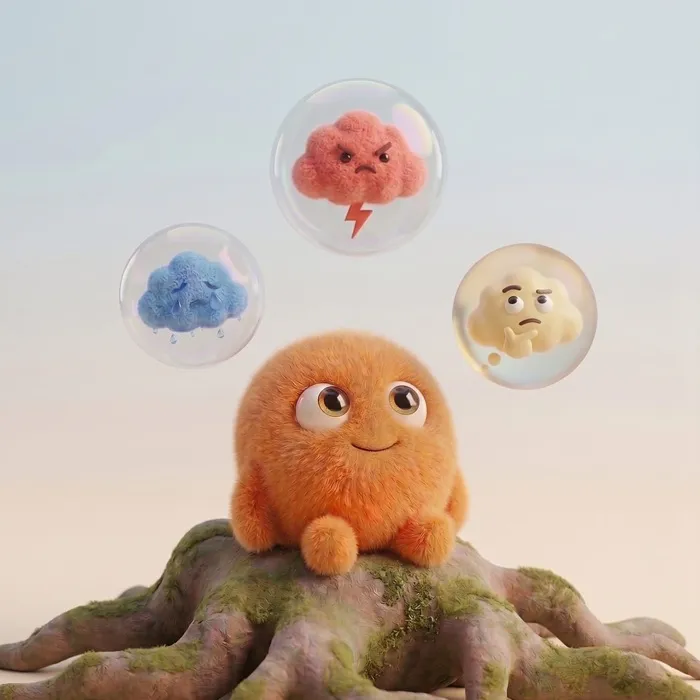
 Lumi

How big is the feeling?
tiny
small
medium
big
huge
How to use a feelings chart
- Start on a calm day. Go through the faces together and make each one. A chart introduced in the middle of a meltdown becomes one more thing to fight about.
- Point first. Many kids ages 4 to 8 can point at a face long before they can say the word.
- Add the size. “Angry, and how big? A 2 or a 5?” The number tells you whether to talk or to wait.
- Use it for good feelings too. If the chart only comes out for bad moments, kids stop wanting to look at it.
- Go first. “I’m a worried 3 about being late.” Kids learn the words by hearing you use them.
One exercise that goes with the chart
They come from Lumi and take about five minutes each.

Where Does This Feeling Live?
5–7 minutes · You need: Imagination
This exercise helps children connect feelings with body sensations. When a child learns to find where a feeling “lives” in the body, the feeling often becomes less overwhelming. The child learns to notice body sensations without fighting them. If focusing on the body makes your child more upset, stop and switch to something outside: name three things you can see.
- A Visitor Has Arrived. Explain that every feeling visitor, like Anger, Fear, Sadness, or Worry, likes to stay somewhere in the body. Together, you’ll look for where it’s staying right now.Say: “It looks like a feeling visitor has arrived. Let’s find where it’s staying in your body right now. Ready to look?”
- Search the Body’s Rooms. Gently check the main “rooms” of the body together: the belly, chest, throat, shoulders, hands, and face.Say: “Let’s look in your tummy first. Is it calm, tight, jumpy, or twisty? Now put a hand on your chest. What do you notice there? Maybe the visitor is in your shoulders or hands.”
- Describe the Visitor. Once the place is found, describe the feeling there. Use kid-friendly comparisons: heavy like a stone, prickly like a cactus, shaky like jelly, warm like cocoa.Say: “Oh, you found it! What is it like there? Is it hard or soft? Heavy or light? If we could color it, what color would it be?”
- Let the Visitor Stay. This is the part where we let the feeling be. We’re not trying to kick it out. We simply say, “Yes, it’s here,” and let it stay for a while.Say: “Let’s say to this feeling, “Hi. I know you’re here. You can stay for a bit. I’m not pushing you away.” What do you notice now?”
- Breathe Toward That Place. Invite your child to send a soft breath toward the place where the feeling lives. This isn’t to make the feeling disappear. It’s to care for the body while the feeling is there.Say: “Take a slow breath and imagine your breath out is a soft cloud around the feeling. We’re just breathing near it. How does your body feel now? If it still feels big, that’s okay.”
Also in Lumi, with voice and pictures:
- Smiley Journal · 5–10 minutes. This simple ritual helps children notice their own inner weather.
- Feelings and Messages · 7–10 minutes. This exercise helps children make friends with uncomfortable feelings by seeing them as useful signals.
Why naming feelings helps
Recognizing and labeling emotions are two of the five skills in RULER, the approach to emotional intelligence developed at the Yale Center for Emotional Intelligence and used in schools. A chart is a simple way to practice both at home.
The chart fits well in a calm-down corner. If your child’s school uses colors for feelings, see Zones of Regulation at home.
Want the same eight feelings as separate cards to cut out? See the printable feelings cards (PDF).
Prefer a circle? The same eight feelings are on the feelings wheel.
Lumi is a set of self-help exercises for families. It isn’t a treatment and doesn’t replace a pediatrician or a child psychologist. In an emergency, call 911. For a mental health crisis, call or text 988.
Sources
- RULER, Yale Center for Emotional Intelligence.
Questions parents ask
What age is a feelings chart for?
This one is made for kids ages 4 to 8. Younger children can point at the faces; older ones can add the 1 to 5 size.
How many feelings should a chart have?
For ages 4 to 8, six to eight is plenty. Start with happy, sad, angry and scared, then add the rest.
How often should we use it?
Once a day at a regular time works well, for example after school or at bedtime, plus whenever a feeling gets big.